Costco Tariff Strategy for CPG Brands 2026: How to Protect Your Vendor Relationship When Costs Rise

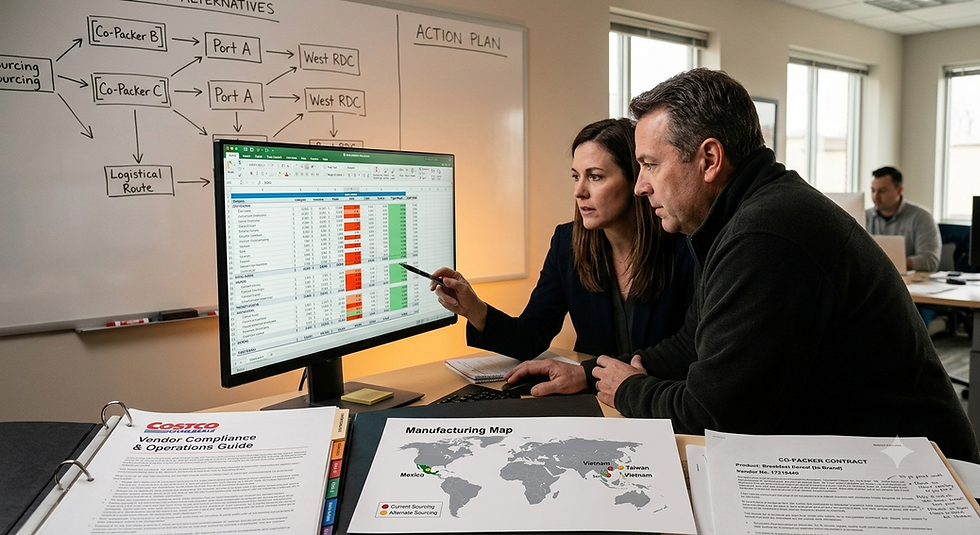
CEO Ron Vachris said it explicitly during Costco's Q2 2026 earnings call, in language that every CPG brand in the Costco channel should have studied carefully: "Our strategies include moving the country of production when that makes sense, consolidating buying efforts globally to lower the cost of goods, leaning in on Kirkland Signature where we have the most control of the supply chain, and sourcing more items domestically."
Four specific responses. In order of institutional preference. And for CPG brands whose Costco programs depend on maintaining pricing viability at Costco's margin structure, understanding exactly what each of those four responses means for their vendor position is commercially essential.
The tariff environment of 2025 and 2026 created the most significant cost-of-goods pressure in the Costco vendor ecosystem in recent memory. The complexity of layered tariffs — different rates on different product categories from different countries of origin, changing at irregular intervals with minimal notice — made precise cost modeling difficult for most brands and forced Costco's buying team into contingency planning that directly affects which vendor programs are maintained, expanded, reduced, or eliminated.
This guide provides the complete strategic framework for CPG brands navigating the Costco channel in a tariff-affected cost environment — what Costco's buying team is doing institutionally, what the implications are for different vendor categories, the specific risks that brands importing from tariffed countries face, and the concrete actions that protect vendor relationships when cost pressures threaten pricing viability.
Understanding Costco's Institutional Tariff Response
Costco's institutional response to tariff-driven cost pressure has four components, each with distinct implications for the CPG vendor community.
Response 1: Moving country of production.
"Moving the country of production when that makes sense" — this is the buyer team's first-pass response to tariff cost pressure on imported goods. When a product is manufactured in a tariffed country and the tariff creates a cost structure that cannot sustain Costco's member pricing model, the buyer's first question is whether the manufacturing can move to a lower-tariff or tariff-exempt country without compromising quality or lead time.
For CPG brands whose manufacturing is concentrated in China — which faced the most significant U.S. tariff escalation of the 2025 cycle — this buyer-initiated question about country of production is not a hypothetical. It is a real and active conversation that buyers are having with their vendor community. Brands that have a credible answer — a validated alternative manufacturing option in a lower-tariff geography, a domestic co-packer with sufficient capacity, a Mexico or Canada sourcing relationship that is viable under USMCA terms — are in a significantly stronger position than brands whose answer is "we can only manufacture in China."
The brands that should be most concerned: any CPG brand manufacturing in China whose COGS increase from tariff burden is compressing the margin available for Costco member pricing below the threshold where the member retail price can be maintained at a competitive level.
Response 2: Consolidating global buying to lower cost of goods.
"Consolidating buying efforts globally to lower the cost of goods" is Costco's institutional leverage play — using the volume commitment of its entire global purchasing program to negotiate cost reductions with suppliers and manufacturers that offset tariff burden through volume-driven unit economics.
For CPG vendor brands, this response is primarily an institutional Costco action rather than a direct vendor implication. But its indirect implication is significant: it confirms that Costco is actively working to maintain its member pricing standard through multiple cost-reduction pathways simultaneously. When Costco's global buying team is consolidating volume to lower costs, individual brands whose cost structures cannot accommodate this dynamic face pressure to demonstrate their own cost reduction pathway or risk being displaced by an alternative that achieves the target economics.
Response 3: Leaning in on Kirkland Signature.
This is the response with the most significant direct implications for national brands in the Costco channel. "Leaning in on Kirkland Signature where we have the most control of the supply chain" is Costco's most powerful institutional response to tariff-driven cost pressure — and the one that most directly threatens the assortment positions of national brands in categories where a Kirkland alternative is either currently available or commercially viable to develop.
Analysts project Kirkland Signature could reach 35 to 40 percent of total Costco sales by 2030, up from roughly 33 percent today. In a tariff-heavy environment, leaning further into domestic and private-label sourcing gives Costco pricing flexibility that brand-dependent competitors lack. Each percentage point of additional Kirkland penetration improves margin mix because Kirkland products carry higher margins than national brands.
The implication for CPG brands is direct and specific: when Kirkland's supply chain flexibility allows it to maintain member pricing at Costco's standard while a national brand's imported supply chain faces tariff-driven cost increases that cannot be fully absorbed, the buying team's pressure to lean into Kirkland accelerates. The national brand that cannot maintain its Costco cost price — the price at which Costco sells the product to members at the required margin — faces an accelerated displacement timeline by a Kirkland alternative.
This is not hypothetical. Costco has launched Kirkland alternatives in categories previously occupied by national brands. It launched the Kirkland Sparkling Energy Drink at $16.99 for a 24-pack in direct response to Celsius pricing at $37.99. It launched Kirkland protein bars in direct competition with national brands in the protein segment. When the cost dynamics favor Kirkland — which tariff-driven cost increases on imported national brands typically do — the institutional pressure to develop and promote the Kirkland alternative intensifies.
Response 4: Sourcing more items domestically.
"Sourcing more items domestically" reflects both the tariff mitigation logic and a sustainability and supply chain resilience strategy that has been building at Costco for several years. Costco already has several regional buyers across the U.S. who source local and specialty products. The 2026 commitment is to expand this domestic sourcing program — creating more Kirkland products manufactured domestically and accelerating the review of import-dependent vendor programs in light of tariff exposure.
For CPG brands with U.S.-based manufacturing or viable U.S.-based co-manufacturing relationships, this domestic sourcing priority is a competitive advantage in the current environment. Brands that can credibly communicate their U.S. manufacturing footprint — or their validated pathway to domestic manufacturing — are better positioned for buyer conversations in 2026 than brands whose supply chains are import-dependent.
The Risk Profile by Vendor Category
Not all CPG brands in the Costco channel face equal tariff risk. The specific risk profile depends on the intersection of three variables: country of manufacturing origin, product category, and the availability of a Kirkland alternative in that category.
Highest tariff risk: China-manufactured, branded, category with available Kirkland alternative.
This is the highest-risk vendor profile in the current environment. A brand manufacturing in China faces maximum tariff burden. Its Costco cost price is under maximum pressure. And if the category already has or can credibly support a Kirkland alternative, the buying team's institutional preference for Kirkland — when national brand cost structures are deteriorating — is most likely to be exercised. Brands in this quadrant need a clear, credible, near-term manufacturing transition plan if they want to protect their Costco vendor position.
High risk: China-manufactured, branded, category without current Kirkland alternative.
The Kirkland displacement risk is lower here because no immediate alternative exists — but the COGS pressure from tariffs remains, and if the cost structure cannot be maintained, the buying team's response options include reducing order volume, price negotiation, or initiating Kirkland development in the category. Brands in this quadrant have more time than the highest-risk profile but need a cost mitigation pathway documented.
Moderate risk: Non-China import, moderate tariff exposure, branded.
Countries of manufacturing that faced moderate tariff treatment in the 2025-2026 cycle include Vietnam, India, and Southeast Asian nations outside China. The tariff burden is real but meaningfully lower than China exposure. The COGS pressure is more manageable, and brands with Southeast Asian manufacturing relationships have more flexibility to adjust production allocation or negotiate cost reductions with existing manufacturing partners.
Lower risk: U.S.-manufactured, USMCA-eligible, or tariff-exempt.
Brands manufactured domestically or in USMCA countries (Canada and Mexico, subject to rules of origin requirements) face the lowest tariff burden in the current environment. The domestic manufacturing advantage is not just about tariff avoidance — it is about supply chain resilience, lead time compression, and alignment with Costco's stated institutional preference for domestic sourcing. CPG brands with U.S. or USMCA manufacturing should be actively communicating this as a competitive advantage in buyer conversations.
Costco's Pricing Discipline Under Tariff Pressure: What Vendors Need to Understand
Costco's institutional commitment to member pricing — the foundational commercial promise that the warehouse delivers extraordinary value to members — means that Costco has been unwilling to pass tariff costs fully to members, even when doing so would have been financially straightforward. And in many cases, Costco did not pass the full cost of tariffs onto members, absorbing a portion of the cost increase to maintain price stability.
This institutional price protection behavior has significant implications for CPG vendor brands:
First, Costco's absorption of tariff costs is not unlimited or permanent. The buying team has communicated that cost pressure from tariffs is being managed through the four strategies described above — not through indefinite Costco margin absorption. When Costco's margin absorption has been exhausted on a specific product, the pressure returns to the vendor cost structure.
Second, Costco's internal economics require that vendor cost prices maintain the margin structure that allows the member price to be competitive. A vendor cost price increase — even a modest one driven by legitimate tariff burden — that pushes the member retail price above the level that creates compelling member value triggers a buyer review that the vendor may not win.
Third, Costco has actively pursued IEEPA tariff refunds through the legal system. The company filed a lawsuit in late 2025 seeking a full refund for tariffs paid during the year. The Supreme Court ruled in February 2026 that such tariffs were unlawful, and Costco is pursuing the refund process through the Court of International Trade. This legal action signals that Costco is treating the tariff environment as anomalous rather than structural — and is positioning for a return to pre-tariff economics when the legal and trade policy landscape permits.
The Vendor Action Framework: What to Do Before the Next Buyer Review
For CPG brands currently in the Costco channel with tariff-exposed supply chains, the strategic priority is demonstrating to the buying team — before the next buyer review, not after — that the brand has a credible and documented cost management strategy that protects the Costco pricing viability of the program.
Action 1: Build the Costco-specific tariff impact P&L.
Quantify specifically what the tariff burden costs per unit at the current Costco cost price. This is the document the buyer needs to understand your cost situation — and the document that frames the conversation around the solution rather than the problem. If the tariff burden is $0.50 per unit and the Costco cost price is $8.50, the member retail impact at Costco's markup is approximately $0.57. This is the specific and concrete commercial impact that the buyer needs to see quantified, not estimated.
Action 2: Document the manufacturing transition pathway.
If the cost management strategy includes moving manufacturing from a tariffed country to a lower-tariff or domestic source, document the transition timeline, the validated co-manufacturing relationship, the quality standard confirmation, and the cost per unit at the new manufacturing source. A documented and credible transition plan is dramatically more buyer-protective than a verbal commitment to explore alternatives.
Action 3: Proactively communicate with your buyer before costs become a crisis.
The vendor that communicates a tariff challenge proactively — before it manifests as a requested cost price increase or a shipment compliance failure — is in a fundamentally different buyer conversation than the vendor that surfaces the problem when it has already become a disruption. Buyers respond to proactive, solution-oriented communication from vendors who demonstrate they understand the institutional priorities and are working to protect the commercial relationship.
The communication framework: "We wanted to brief you on the specific tariff impact we are managing in the current environment, what it means for our cost structure, and the specific pathway we have identified to maintain the Costco pricing viability of the program. We are not requesting a price change — we are sharing our strategy for avoiding one." This framing positions the brand as a sophisticated commercial partner managing a shared challenge rather than a vendor seeking relief.
Action 4: Evaluate co-manufacturing alternatives proactively.
The domestic co-manufacturer who has capacity for your production volume, who meets Costco's food safety and quality standards, and who can produce your product at a cost that maintains the Costco pricing viability — this is the most commercially valuable relationship you can develop in the current environment. Building this relationship before it is urgently needed gives you negotiating leverage, quality control time, and the ability to present a validated domestic sourcing option to your buyer rather than a hypothetical future possibility.
Action 5: Assess Kirkland displacement risk in your category.
The Kirkland displacement risk assessment is the most strategically important — and most consistently avoided — analysis that CPG brands in the Costco channel should be conducting. The framework: does a Kirkland alternative currently exist in your category? If not, could one be developed based on the size of the category and the availability of manufacturing partners with relevant capability? What would the member retail price of a Kirkland alternative be, and how does it compare to your current member retail price? What would the Kirkland alternative need to match in terms of your product's specific claims or quality attributes, and could it credibly do so?
If the displacement risk assessment indicates meaningful Kirkland vulnerability — which most national brands in commodity-adjacent categories should assume — the strategic response is to invest in the differentiation dimensions that Kirkland cannot match: brand narrative, clinical credentialing, roadshow demonstration, and the category innovations that build the case for the brand's irreplaceability in the assortment.
The Domestic Sourcing Opportunity: Turning Tariff Challenge Into Competitive Advantage
The tariff environment's most commercially interesting dimension for CPG brands with viable domestic manufacturing is the opportunity to convert a structural industry challenge into a competitive advantage in Costco buyer conversations.
More Kirkland products will be sourced locally in 2026 and beyond. This change is part of a strategy to cut the company's carbon footprint and minimize the impact of tariffs and other rising costs. Costco adjusted supply chains in international markets like Mexico and Canada to avoid tariff exposure during 2025, and the company plans to build on these successful efforts in 2026.
For a CPG brand with U.S. manufacturing, the buyer conversation in 2026 includes a competitive differentiator that import-dependent brands cannot credibly claim: domestic supply chain stability, tariff immunity, and alignment with Costco's stated institutional sourcing direction. This is not a marginal advantage. It is a genuine and meaningful competitive positioning in a buyer environment where supply chain resilience and cost stability have become primary vendor evaluation criteria alongside product quality and velocity.
The strategic recommendation: if your manufacturing footprint is currently import-dependent and domestic manufacturing is economically viable for your product, the tariff environment has accelerated the commercial justification for domestic manufacturing investment that might previously have been justified primarily on lead time and quality control grounds. The tariff immunity, the buyer relationship protection, and the alignment with Costco's domestic sourcing direction add meaningful additional value to the domestic manufacturing decision.
At Fractional Brand Managers, we help CPG brands assess their Costco tariff exposure, build the cost management documentation their buyers need to see, develop the manufacturing transition strategies that protect pricing viability, and frame the buyer conversation in the way that preserves the commercial relationship through a challenging operating environment.
Contact us at 732-433-7873 or info@fractionalbrandmanagers.com before your next buyer review.
Costco Tariff Risk Assessment Framework 2026:
Risk Category | Manufacturing Source | Kirkland Category Status | Recommended Action |
Highest | China | Kirkland alternative available | Immediate manufacturing transition plan |
High | China | No Kirkland alternative currently | Cost mitigation pathway + displacement risk assessment |
Moderate | Vietnam/India/SE Asia | Category situation varies | Monitor, negotiate co-packer costs, prepare alternatives |
Lower | U.S./USMCA | Any | Communicate domestic advantage proactively to buyer |
Lowest | Domestic U.S. | Any | Leverage as competitive differentiator in buyer relationship |
#CostcoTariffStrategyCPGBrands2026 #CostcoTariff2026 #CPGTariffStrategy2026 #CostcoVendorTariff #KirklandDisplacementRisk #CostcoSupplyChain2026 #CPGSupplyChain2026 #FractionalBrandManagers #CostcoChannel2026 #CPGBrands2026 #CostcoVendor2026 #TariffCPG2026 #CostcoBuyer2026 #DomesticSourcing2026 #CPGManufacturing2026 #CostcoKirkland2026 #TradePolicy2026 #CPGStrategy2026 #CostcoProgram2026 #SupplyChainStrategy


Comments