Costco Brand Growth Strategy for CPG: How to Scale From Regional Test to National Program

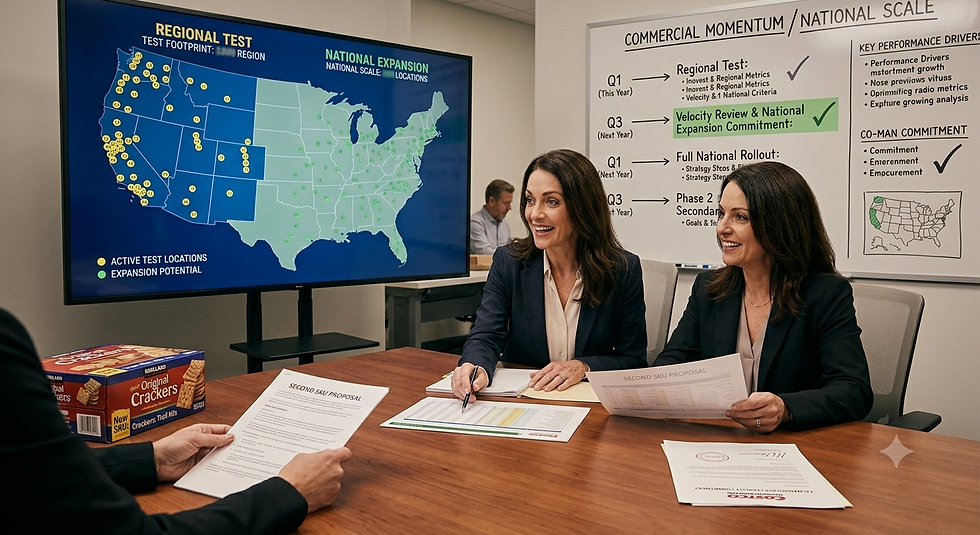
Getting a product into the Costco channel is the achievement that most CPG brands describe as the summit — the milestone that validates the brand's commercial potential and unlocks the revenue scale that changes the company's trajectory.
But the brand founders who have been through the Costco journey know something that aspiring Costco vendors do not: the first purchase order is not the summit. It is the base camp.
The first purchase order — typically a regional test across 40 to 60 warehouse locations — generates meaningful revenue, provides institutional credibility with other retail buyers, and creates the sell-through data that Costco's buying team will use to make the most commercially consequential decision in the brand's Costco relationship: whether to expand to a national program.
That expansion decision — from regional test to national distribution across 250 to 400 or more U.S. warehouse locations — is the event that transforms a promising Costco program into a brand-defining channel. The revenue difference between a 60-location regional test and a 300-location national program, at equivalent velocity, is a factor of five. A regional program generating $500,000 per year becomes a $2.5 million channel when it goes national. A $1 million regional program becomes a $5 million channel.
The strategies, the specific behaviors, and the operational commitments that move a brand from regional test to national program — and then from national program to a sustained, growing, multi-year Costco relationship — are the subject of this guide.
Understanding the Regional Test: What Costco Is Actually Evaluating
Most new Costco vendor relationships begin with a regional test — a limited distribution program typically covering one Costco buying region, which may correspond to 40 to 80 warehouse locations depending on the region and the buying team's initial confidence in the product's commercial potential.
The regional test is not a trial period before a decision. It is a structured data collection exercise that the buying team uses to make an evidence-based expansion decision. The data being collected includes:
Sell-through velocity — the number of units sold per location per week, measured across the full test period. This is the primary metric. The velocity data from the regional test is the most commercially significant performance measure the buying team has available — real-world, real-member, real-warehouse floor evidence of whether Costco members are choosing this product.
Velocity consistency — whether the sell-through rate is consistent across the test period or whether it shows a spike-and-decline pattern typical of novelty purchases that do not sustain. A product with consistent or growing weekly velocity across a full seasonal cycle is demonstrating genuine member demand. A product with strong early velocity that declines to very low levels within four to six weeks is demonstrating novelty appeal without repeat purchasing.
Operational reliability — whether the brand fulfilled every purchase order completely and on time, without significant compliance failures. The buying team's risk assessment of the vendor relationship is updated continuously by the operational record. A regional test that includes delivery failures, ASN inaccuracies, or significant chargeback claims communicates that operational scaling to national distribution will generate proportionally larger problems.
Member feedback — the qualitative signal from member interactions with the product. Warehouse staff observations, member complaint rates, and the member review data on Costco.com for the test regions all contribute to the buying team's qualitative assessment alongside the quantitative velocity data.
The Velocity Benchmark: What Number Triggers National Expansion
The specific velocity threshold that triggers a buyer's recommendation for national expansion is not publicly disclosed by Costco. It varies by product category — food and beverage products with daily consumption occasions require higher velocity to justify the assortment position than specialty or occasional-use products. Seasonal items are evaluated on different velocity standards than year-round consumables.
What experienced Costco channel partners observe consistently is the following general framework:
Products achieving 25 or more club-pack units per location per week, consistently across the regional test period, generate strong buyer enthusiasm for national expansion. At this velocity, the product is generating roughly $1.3 to $1.8 million in annual revenue per 300-location national distribution at typical price points — a commercial scale that clearly justifies the assortment position and that the buying team can confidently recommend to their management.
Products achieving 15 to 24 units per location per week occupy a more nuanced position. They are generating meaningful revenue and demonstrating genuine member demand, but they may prompt the buying team to seek additional performance data before recommending national expansion — a second seasonal cycle, a roadshow event to test velocity acceleration, or a pricing adjustment to improve member value and close the velocity gap to the expansion threshold.
Products achieving fewer than 15 units per location per week over a sustained regional test period are typically in the conversation range where the buying team is evaluating whether operational or pricing changes can improve performance, or whether the product is not the right fit for the assortment at this stage.
The strategic implication: brands entering a regional test should know in advance what velocity threshold they are targeting, what the supporting marketing and operational activities are that will drive velocity toward that threshold, and what their response plan is for each possible velocity outcome at the regional test's conclusion.
The Roadshow Strategy Within a Regional Program: The Velocity Accelerator
For CPG brands in a regional test program, the roadshow is the single most powerful tool available for driving sell-through velocity toward the expansion threshold — and it is consistently underused by brands that treat the roadshow as a separate activity rather than an integrated component of the regional test strategy.
Roadshows are 7 to 14 day in-warehouse demonstrations where a brand sets up a station, samples product, and drives in-warehouse sales. Strong performance at 10 or more roadshows usually leads to a buying decision for permanent placement.
The velocity effect of a roadshow event at a participating warehouse location is measurable and significant. During a roadshow week, the product's weekly sell-through at that location typically accelerates two to five times above the baseline sell-through rate. This acceleration reflects the combination of product awareness among members who had not yet noticed the product on the warehouse floor, the trial experience created by sampling, and the conversion from trial to purchase that a well-trained brand specialist creates through direct member engagement.
More importantly than the in-week acceleration, a successful roadshow event leaves a post-roadshow velocity legacy — a sustained uptick in the product's baseline sell-through at that location after the roadshow ends. Members who tried the product during the roadshow and purchased it continue to purchase it on subsequent visits. The post-roadshow baseline velocity is typically 20 to 40 percent higher than the pre-roadshow baseline at the same location.
For a brand in a regional test with 60 locations, running roadshows at 10 to 15 locations during the test period generates both the in-week velocity acceleration and the post-roadshow baseline improvement that collectively raise the regional average velocity meaningfully. The buyer who reviews velocity data from a region where strategic roadshows have been conducted sees a product with higher average velocity than the same product would generate without roadshow support — and that higher average velocity is the data point that drives the expansion recommendation.
The roadshow investment calculation: a typical roadshow event costs $5,000 to $15,000 per warehouse for a one-week engagement, covering the brand specialist staffing, product sampling inventory, and the demonstration setup. For a brand at 20 units per location per week baseline, if the roadshow drives a post-event velocity improvement of 25 percent — from 20 to 25 units per week — the incremental annual revenue per location from that improvement exceeds $20,000 at most price points. The math on roadshow ROI for brands in the expansion-critical velocity range is strongly favorable.
The 20% Revenue Concentration Rule: Why Growth Must Be Managed
The Costco channel's commercial appeal — the extraordinary per-SKU revenue that a successful national program generates — creates a specific and counterproductive risk for CPG brands that grow their Costco program too aggressively relative to their other channels.
Costco generally does not want to represent more than 20 percent of a vendor brand's total annual revenue. This guideline — referenced consistently across industry discussions of the Costco vendor relationship — reflects Costco's institutional interest in working with growing, commercially independent brands rather than brands whose financial stability depends on the continued health of the Costco relationship.
The commercial logic is straightforward from Costco's perspective: a vendor brand for whom Costco represents 60 or 70 percent of total revenue is a brand that faces existential risk if the Costco program is reduced or discontinued for any reason. A brand in existential financial risk is a vendor relationship liability — a partner whose operational and quality management is likely to deteriorate under the stress of the revenue dependency, and whose program management will be distorted by the inability to make any commercial decision that risks the Costco relationship.
For growing CPG brands, the 20% guideline creates a specific and important growth constraint: the Costco program should grow in proportion with the brand's total revenue, not faster than it. A brand that achieves a $2 million regional Costco program while maintaining $10 million in total revenue is managing the Costco concentration at 20 percent. A brand that achieves the same $2 million Costco program while total revenue is $3 million is at 67 percent concentration — a position that makes the brand more dependent on and more vulnerable to the Costco relationship than is commercially healthy.
The practical growth strategy implication: brands entering the Costco channel should simultaneously invest in diversifying and growing other channel revenue — DTC, Amazon, specialty retail, food service — so that Costco's growth as a percentage of total revenue stays within the 20% guideline as the program scales. The brand that presents a buyer with evidence of strong multi-channel growth is demonstrating the commercial independence and institutional health that the Costco buying team values in long-term vendor partners.
The Second SKU: When and How to Propose It
For brands whose first Costco SKU is performing strongly — consistently hitting or exceeding the velocity benchmark, with a clean operational record and a positive buyer relationship — the second SKU proposal is the next strategic milestone in the program growth trajectory.
A second Costco SKU is not simply a second product. It is a second assortment position — a second commitment from the buying team, a second line on the operational compliance scorecard, and a second revenue stream within the channel. The commercial logic of the second SKU for the brand is compelling: a second product at similar velocity doubles the channel revenue from the same buyer relationship.
The buyer's logic for approving a second SKU is more cautious: the buying team must justify to their management not just that the second product is good, but that it deserves an assortment position in a 3,800-SKU constraint where every position is occupied and every addition displaces something else. The second SKU conversation is easier when the first SKU is performing strongly — but it is still a new commercial argument that must be made independently of the first SKU's success.
The optimal timing for a second SKU proposal: after at least 6 to 12 months of strong first SKU performance in the regional test or national program, with velocity data that clearly demonstrates member demand beyond the novelty period, and with an operational compliance record that is clean enough to suggest the second SKU can be managed without adding operational risk to the buyer relationship.
The second SKU positioning strategy: the second product should be differentiated from the first in a way that expands the category's commercial appeal to members who were not converted by the first SKU. A different format, a different flavor, a different use occasion, or a genuinely different benefit positioning that reaches members who the first SKU does not.
The second SKU that simply duplicates the first at a different size or minor flavor variation does not make a strong case for a new assortment position.
The SKU rationalization risk: occasionally, the second SKU conversation surfaces a buyer interest in replacing the first SKU with the second rather than adding both. For brands whose first SKU is approaching the end of its commercial lifecycle — declining velocity, aging packaging, increasing competition from newer alternatives — the second SKU may be the mechanism through which the buyer transitions the assortment to the newer offering while discontinuing the original. This transition is not a commercial failure — it is program evolution — but it requires careful positioning to ensure the transition maintains continuity in the buyer relationship and in the brand's revenue from the channel.
The International Expansion Pathway: Costco Beyond the U.S. Market
For brands with established U.S. Costco programs and the supply chain capacity to address international markets, the Costco international expansion pathway represents one of the most commercially accessible entry points into international retail distribution available to any CPG brand.
Costco's global footprint of 924 warehouses across 14 countries includes 114 locations in Canada, 42 in Mexico, 37 in Japan, 29 in the United Kingdom, 20 in Korea, 15 in Australia, 14 in Taiwan, 7 in China, 5 in Spain, and growing presence in Sweden, France, and Iceland.
Each international market has its own buying team, its own regional assortment decisions, and its own performance standards — but the institutional framework of the Costco brand and the membership model is consistent globally.
For U.S. Costco vendors, the most natural international expansion pathway is Canada — where Costco operates with the same institutional framework as the U.S., where English-language packaging often requires only bilingual label addition (French-English) rather than full reformulation, and where the same buyer relationship framework applies.
The U.S. buyer relationship does not automatically transfer to the Canadian buying team — international expansion requires separate buyer engagement, separate product submission, and separate performance evaluation in each market. But the credibility transfer is real: a brand with a successful, documented U.S. Costco program enters the international buyer conversation at a meaningfully higher starting trust level than a brand with no Costco history.
The U.S. velocity data is the most compelling commercial proof point available for an international expansion conversation.
The Japan and Korea markets present specific regulatory and labeling requirements that add complexity to the expansion process but that the institutional Costco framework helps navigate — the buyer relationship in each market provides guidance on local requirements and can facilitate introductions to the compliance resources needed for market entry.
The Multi-Year Program Strategy: Building Durability Into the Costco Relationship
The brands that build the most commercially durable Costco programs are the ones that think in multi-year cycles rather than annual performance periods — and that invest continuously in the three dimensions of durability that compound over time: operational excellence, buyer relationship quality, and product innovation investment.
Operational excellence accumulates as a reputation asset. The brand that has delivered every purchase order on time, with clean ASN accuracy, zero compliance chargebacks, and consistently accurate invoicing for three consecutive years has built an operational reputation that is genuinely difficult for a new entrant to displace — because the risk-averse buying team knows exactly what level of execution to expect from this vendor, and the certainty of that expectation has commercial value.
Buyer relationship quality is an institutional asset that protects the program through challenging periods. The buyer who has worked with a brand's team through three years of honest communication, proactive problem disclosure, and collaborative solution development has a fundamentally different relationship with that brand than the buyer has with a vendor they barely know. When category pressure, tariff impacts, or competitive alternatives prompt the buyer to evaluate assortment changes, the deep relationship with an established brand creates a consultative dynamic rather than an adversarial one.
Product innovation investment signals the forward trajectory of the program. A brand that has reformulated, expanded certifications, introduced a second flavor, or developed a genuinely novel product extension in the past 12 months is communicating to the buyer that the Costco position is valued, that the brand is investing in it, and that the assortment position will generate new commercial energy in the coming year. The brand that arrives at every annual review with only historical performance data — nothing new, nothing developing, no pipeline to discuss — is presenting itself as static. The brand that arrives with both a strong historical record and a compelling forward pipeline is presenting itself as a growing partner.
At Fractional Brand Managers, we develop the multi-year Costco channel growth strategy for every client engagement — building the roadshow calendar, the second SKU development pathway, the operational excellence investment plan, and the buyer relationship management approach that converts a successful regional test into a national program and a national program into a sustained, growing multi-year relationship.
Contact us at 732-433-7873 or info@fractionalbrandmanagers.com to build your Costco growth strategy.
Costco Brand Growth Pathway Quick Reference:
Stage | Revenue Benchmark | Key Activity | Growth Driver |
Regional test | $400K-$800K/year | Velocity optimization, roadshow events | Reaching velocity expansion threshold |
National program | $2M-$5M/year | Operational scaling, velocity maintenance | Clean first shipment, buyer confidence |
Established national | $5M-$12M/year | Second SKU development, category defense | Innovation pipeline, relationship depth |
Multi-year program | $10M+/year | International pathway, buyer relationship | Operational reputation, product evolution |
The 20% Revenue Concentration Rule:Costco program should stay at or below 20% of total brand revenue. If Costco grows faster than the rest of the business, invest in multi-channel revenue diversification simultaneously.
#CostcoBrandGrowthStrategyCPG2026 #CostcoCPGGrowth #CostcoNationalExpansion2026 #CostcoRegionalTest #CostcoVelocityBenchmark #CostcoSecondSKU #CostcoRoadshowStrategy #CostcoInternational2026 #FractionalBrandManagers #CostcoChannel2026 #CPGBrands2026 #CostcoVendor2026 #CostcoBuyer2026 #CPGGrowthStrategy2026 #CostcoMultiYear #CostcoScaling #CPGRetailGrowth #CostcoExpansion #BrandGrowthCostco #CPGStrategy2026


Comments