Costco Category Management Strategy 2026: How CPG Brands Survive the Annual Assortment Review

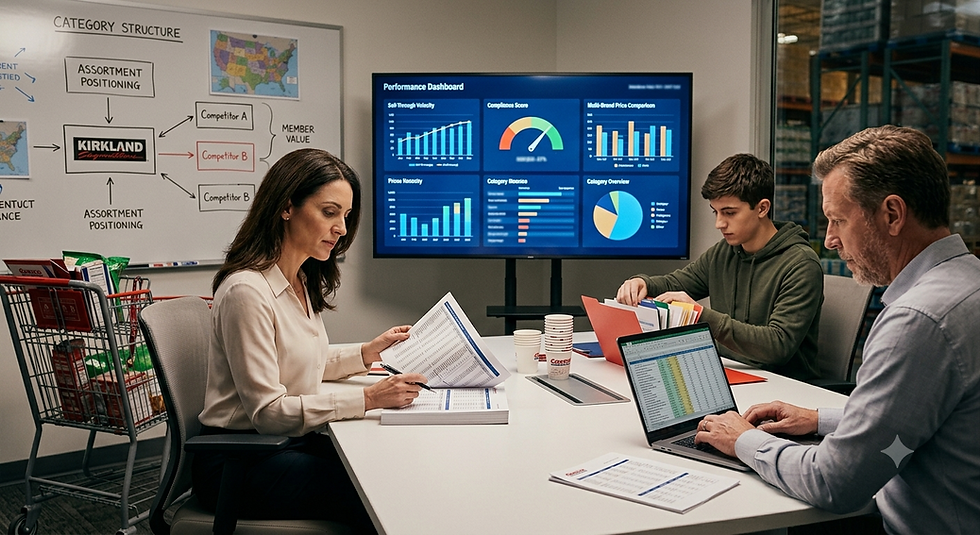
Each Costco SKU represents an enormous volume commitment — because with so few SKUs in the assortment, each product that earns a place generates sales volumes that are dramatically higher per SKU than at retailers with broader assortments. This volume concentration gives Costco's buyers institutional leverage in supplier negotiations that translates directly into the product pricing and quality standards that make the warehouse's member value proposition possible.
The sentence that most CPG brands in the Costco channel need to internalize and never forget is embedded in that quote: each product that earns a place.
Earns. Present tense. Continuously.
The Costco assortment position is not a permanent allocation. It is a continuously evaluated commercial relationship between the brand's performance — its sell-through velocity, its member value delivery, its operational compliance record, its pricing viability — and the buying team's assessment of whether this position is being occupied by the most commercially appropriate product available for that assortment slot.
With approximately 3,800 active SKUs across the warehouse floor — compared to 30,000 or more at a typical supermarket — every product in the Costco assortment is occupying a position that dozens of competing brands would like to occupy. The category review is the institutional mechanism through which Costco's buying team continuously validates that the current occupant of each position is still the best commercial choice for members.
Understanding how the category review works, what it measures, what causes brands to lose their position, and what specifically protects brands from replacement is the category management intelligence that most Costco vendor brands do not have access to — and that this guide provides.
The Structural Reality: How Costco's 3,800 SKU Constraint Shapes Everything
The most commercially significant characteristic of Costco's assortment architecture — the fact that generates both the channel's extraordinary opportunity and its most acute ongoing risk for incumbent brands — is the institutionally maintained SKU constraint.
Costco's limited SKU strategy is the second structural edge. Each warehouse stocks roughly 3,800 items versus 30,000 or more at a typical supermarket. Fewer SKUs mean higher volume per item, which gives Costco's buyers institutional leverage in supplier negotiations.
For the brand that holds a position in this 3,800 SKU assortment, the mathematics are extraordinary: a product that sells at moderate velocity at Costco generates revenue that would require hundreds of conventional grocery stores to match, because each Costco warehouse serves a member community of 60,000 to 100,000 households at a visit frequency that generates dramatically higher per-store volume than any conventional grocery format.
But the same mathematics that make the position valuable make it intensely competitive.
Because every SKU position generates this volume, every SKU position is valuable — to the brand that holds it, to the brands that want it, and to Costco's buying team who must justify to their own management that each position is occupied by the most commercially efficient option available.
The buyer's internal accountability: Costco buyers are typically held to a rigorous standard of sell-through volume that they must hit and because of this they are risk averse. The sell-through velocity of every item in the buyer's assortment is a direct contributor to their individual performance metrics. A slow-moving item does not just represent a commercial inefficiency — it represents a buyer performance problem. The incentive to replace a slow mover with a faster one is institutionally embedded in the buying team's accountability structure.
Understanding the Costco Category Review Cycle
Most conventional retailers conduct formal category reviews on an annual or semi-annual cycle, following a structured planogram reset process. Costco's approach is different in ways
that CPG brands need to understand clearly.
Costco does not have traditional planogram resets. There are no formalized semi-annual category resets where all brands in a category submit JBP (joint business plan) presentations simultaneously and compete for shelf position through a structured review process. The Costco category is managed through the buyer's continuous relationship with the vendor community — a combination of ongoing sell-through monitoring, buyer-initiated conversations when performance concerns arise, and the seasonal inventory transitions that rotate non-food seasonal items through the warehouse on a quarterly cycle.
The practical implication: the "annual review" at Costco is not a single scheduled event. It is the cumulative assessment of the brand's performance that the buyer is conducting continuously — and that can surface as a meaningful conversation at any point when the data suggests a commercial concern.
What triggers a buyer-initiated category review conversation:
Declining sell-through velocity. When a product's weekly units-sold-per-location figure falls below the threshold the buyer has established for category performance, the buyer's attention turns to the cause and the solution. A single slow week is noted. A sustained velocity decline triggers a conversation. A sustained velocity decline without a credible explanation and a credible recovery plan triggers the assortment review.
Compliance failures accumulating. The brand that generates a pattern of chargeback claims — late ASNs, packaging compliance issues, invoice discrepancies, depot delivery failures — is communicating to the buyer that its operational management is not adequate for the institutional reliability that Costco's cross-docking supply chain requires. Compliance pattern failures are not just financial. They are trust erosions that affect the buyer's risk assessment of the vendor relationship.
Member complaint escalation. Costco monitors member feedback on its products through multiple channels — the member review system on Costco.com, direct member contacts to the warehouse, and the informal feedback that flows through frontline warehouse staff. A product that accumulates member quality complaints — packaging that leaks, product that does not perform as claimed, portion sizes that members find inadequate — creates buyer pressure to address the issue or consider alternatives.
Competitor innovation in the category. When a new brand or new product launches in the category with meaningfully stronger member value — better pricing, better quality, stronger innovation differentiation — the buyer's comparison of the incumbent brand against the new competitor generates the question of whether the incumbent is still the best available choice for the assortment position.
Kirkland Signature development in the category. When Costco's buying team determines that a Kirkland Signature alternative can be developed in the category at a cost that supports member pricing at or below the national brand's current position, the institutional pressure toward Kirkland intensifies. This is the category review trigger that national brands most consistently underestimate because it is not visible until the Kirkland development is announced.
The Category Management Metrics That Matter to Costco Buyers
For CPG brands preparing for category review conversations — whether scheduled or buyer-initiated — understanding exactly what the buyer is measuring is the essential commercial intelligence that separates brands that survive reviews from brands that do not.
Sell-through velocity: the primary performance metric.
The most important single metric in a Costco category review is sell-through velocity — the number of units sold per location per week. This is the direct commercial measurement of whether the product is generating the member demand that justifies its assortment position.
A strong velocity figure confirms that members are purchasing the product consistently and that the position generates the revenue per square foot that Costco's institutional sell-through standard requires.
Target velocity levels vary by category — consumable food products typically require higher weekly velocity than durables, premium specialty products, or seasonal items. The specific velocity threshold that triggers buyer concern is not publicly disclosed by Costco. But the pattern is consistent: the brand that maintains or grows velocity is the brand that maintains its position. The brand whose velocity declines without recovery is the brand that enters a buyer conversation about alternatives.
Member value delivery: the comparative price assessment.
Costco's buying team continuously monitors whether the products in the assortment maintain the member value proposition that justifies their position. This is not just about the absolute price — it is about the value relative to what members can find through other channels. A product that delivered extraordinary value compared to Whole Foods and Amazon two years ago may now face competitive alternatives that have closed the value gap. The buyer's ongoing assessment of relative member value is the context in which all velocity data is interpreted.
Operational compliance record: the trust measurement.
The brand's historical compliance record — its on-time delivery rate, its ASN accuracy, its chargeback frequency, its invoice accuracy — is the operational trust metric that the buyer uses to assess the risk profile of the vendor relationship. A brand with a clean compliance record is a low-risk partner. A brand with a pattern of compliance failures is a higher-risk partner — and when the buying team is considering assortment adjustments, higher-risk partners are more vulnerable than lower-risk ones.
Category contribution: the competitive benchmarking assessment.
The buyer evaluates individual brand performance not just in absolute terms but in relative terms — how does this brand's performance compare to what a competitor would deliver in the same position? This category contribution assessment requires the buyer to maintain awareness of competitive alternatives in the market, which is why brands that proactively bring the buyer competitive intelligence — "here is how we compare to the alternatives available to you in this category, and here is why our position continues to deliver better member value" — are giving the buyer a reason to resist competitive pressure rather than evaluate it.
The Category Review Preparation Framework: What Brands Must Have Ready
For CPG brands whose Costco buyer conversation has moved — or is about to move — to the category performance dimension, the following preparation framework provides the complete structure for a category review conversation that defends the assortment position effectively.
Element 1: The velocity dashboard with context.
The sell-through velocity data for the past 12 months, organized by month, with specific contextual annotations for any periods of velocity variation: "October velocity decline attributable to depot delivery delay from Hurricane Milton disruptions in Southeast region, resolved by mid-November." The contextual annotation is critical because the buyer sees velocity data as data. The brand provides the story that explains the data. Without the story, a temporary velocity decline from an external factor looks indistinguishable from a structural performance problem.
Element 2: The member value comparison.
A current, specific, honest comparison of the product's Costco member pricing against the best available alternative in competing channels — the same product or the most directly comparable product at Amazon, Whole Foods, Target, and the product's DTC channel, at comparable unit quantities. The comparison should include not just price but quality differentiators where they apply — certifications, ingredient quality, clinical credentials — that explain why the Costco member is getting a meaningfully better value than the comparison price alone communicates.
Element 3: The compliance record summary.
A clean, organized summary of the brand's compliance performance over the past 12 months: on-time delivery rate, ASN accuracy rate, chargeback rate as a percentage of PO value, and any specific compliance issues with documented resolution. The compliance record summary communicates operational reliability in the specific format that supports a buyer's risk assessment of the vendor relationship.
Element 4: The innovation pipeline.
What is the brand developing that will strengthen the category position in the next 12 months? Reformulation, new flavors, packaging improvements, certifications in process, clinical research in progress — any dimension of product or positioning development that communicates the brand's forward investment in the category position. A brand that can only defend what it has done is less compelling than a brand that can defend what it has done and articulate what it is becoming.
Element 5: The proactive category insight.
The most commercially sophisticated element of a category review preparation — the proactive category insight that demonstrates the brand is not just managing its own position but actively helping the buyer manage the category. This might be trend data about where the category is heading that supports the brand's current positioning. It might be competitive intelligence about a new entrant that the buyer should be monitoring. It might be member feedback data from the brand's own DTC and social channels that provides insight into what the Costco member community is responding to. The brand that brings the buyer commercially relevant information that the buyer could not easily develop independently is positioning itself as a strategic partner rather than a vendor seeking to hold a position.
The Category Position Defense Strategy: Long-Term Structural Protection
Beyond the tactical preparation for specific category review conversations, the most commercially sophisticated CPG brands in the Costco channel invest in structural characteristics that make their category position genuinely difficult for the buying team to replace — regardless of competitive pressure, Kirkland development timelines, or market alternatives.
Structural protection 1: Operational excellence that creates switching costs.
A vendor with a multi-year clean compliance record, a fully integrated EDI relationship, a documented depot delivery precision record, and a smooth replenishment cycle represents a known quantity that the buying team can rely on. Replacing this vendor with a new brand — regardless of how compelling the new brand's product is — requires the complete onboarding cycle, the food safety audit process, the EDI testing and validation, and the first-shipment compliance risk that new vendor relationships always carry. The established vendor's operational excellence creates a switching cost that makes replacement less attractive than incremental improvement.
Structural protection 2: Category definition through brand leadership.
The brand that defines its category position — not just occupies it — is significantly more protected than the brand that could be replaced by any functionally equivalent product. The category-defining brand has built member recognition, has documented sell-through data that proves member demand for this specific product, and has generated the kind of member advocacy (reviews, social sharing, repeat purchase rate) that makes the brand's removal commercially painful rather than commercially neutral.
Structural protection 3: Proactive innovation before buyer pressure.
The brand that innovates before the buyer asks for innovation is making the replacement calculation significantly more complex. A brand that has been reformulated, re-credentialed, or repositioned in the past 12 months is not the same brand the buyer might have considered replacing six months ago. Continuous, proactive investment in the product and the positioning makes the "replace with something better" calculation a moving target rather than a fixed comparison.
Structural protection 4: The buyer relationship as an institutional asset.
The buyer who trusts your brand's team — who has received honest, proactive communication about every challenge before it became a problem, who has experienced the brand's commitment to the institutional relationship over multiple purchase order cycles — is a buyer who brings genuine willingness to the category review conversation rather than a pre-formed replacement recommendation. The buyer relationship is an institutional asset that protects the assortment position in the same way that operational compliance and sell-through velocity do. It cannot be built in a single interaction. It is built through consistent communication, consistent performance, and consistent demonstration that the brand's commercial interests and Costco's institutional interests are genuinely aligned.
At Fractional Brand Managers, we manage the category review preparation and the ongoing buyer relationship management that protects Costco assortment positions for the CPG brands we represent.
Contact us at 732-433-7873 or info@fractionalbrandmanagers.com to build the category management strategy that keeps your position secure.
Costco Category Review Preparation Framework 2026:
Review Element | What It Communicates | Common Mistake |
Velocity dashboard with context | Performance data plus the story that explains it | Presenting data without context for variations |
Member value comparison | Current competitiveness vs. all channels | Using stale or incomplete competitor pricing data |
Compliance record summary | Operational reliability and risk profile | Not tracking compliance data between reviews |
Innovation pipeline | Forward investment in the category position | Only defending what already exists |
Proactive category insight | Strategic partnership, not just vendor management | Bringing no intelligence the buyer doesn't already have |
#CostcoCategoryManagementStrategy2026 #CostcoCategoryManagement #CostcoAssortmentReview #CostcoBuyerReview2026 #CostcoSKUStrategy #CostcoVendorStrategy2026 #CPGCategoryManagement2026 #FractionalBrandManagers #CostcoChannel2026 #CPGBrands2026 #CostcoVendor2026 #CostcoAssortment2026 #CostcoBuyer2026 #CategoryManagementCPG #CPGRetailStrategy2026 #CostcoPosition2026 #AssortmentStrategy #CostcoSellThrough #BrandProtection2026 #CPGStrategy2026


Comments