Costco Canada Supplier Requirements: What a U.S. Brand Must Check Before Selling North

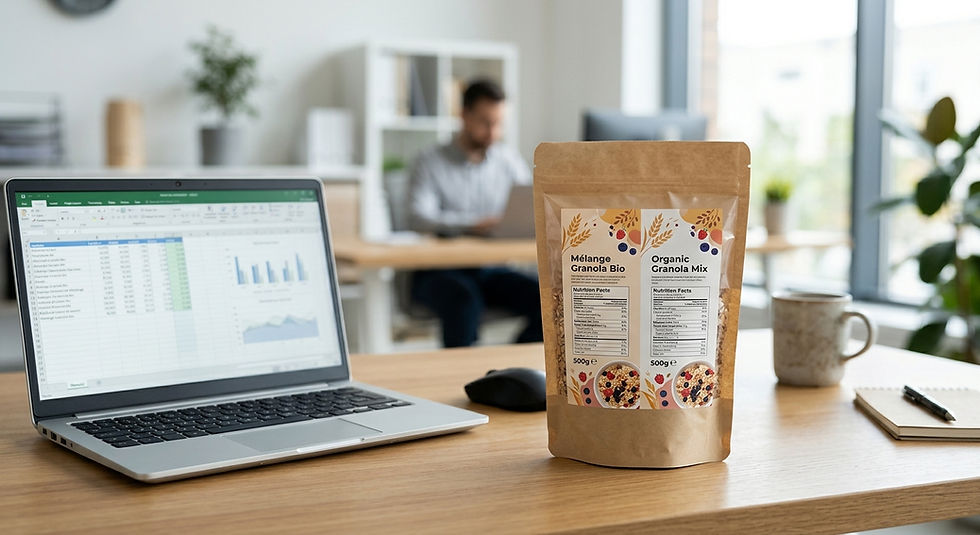
Costco Canada supplier requirements are a question many U.S. brands ask after a strong first year with Costco. Canada is Costco’s second-largest market, and a brand that already works in U.S. warehouses wants to know whether the same product can follow. The answer is “maybe, after some homework,” and most of the homework is on the package.
Today is October 25, 2026. This guide covers the size of the opportunity, what Canadian food labeling rules generally require, what we could not find, and how to organize the work.
A note on sources and what we could not find. We found no Costco-published Canadian supplier or packaging rulebook, and we are not stating one. The opportunity numbers come from Costco’s FY2026 Form 10-K. The labeling summary comes from one third-party regulatory blog that does not quote the Canadian Food Inspection Agency (CFIA) directly. A packaging-translation company page we reviewed did not discuss Costco, so we did not use it. Verify everything with Costco and the CFIA.
The Size of the Opportunity
According to Costco’s 10-K, the company had 939 warehouses worldwide at August 30, 2026, of which 115 were in Canada (96 owned land and building, 19 leased). The filing summary we reviewed also reported that Canada’s net sales grew 10 percent in 2026. We did not find a stand-alone Canadian dollar figure in the portion of the filing we read.
The filing also notes that exchange-rate moves can affect the results of its Canadian and other international operations. For a supplier, currency matters as well: if you price in U.S. dollars and Costco sells in Canadian dollars, your margin and Costco’s can move with the exchange rate. Ask your buyer which currency applies.
Bilingual Labeling: What the Third-Party Source Reports
A Food Label Maker article (published March 2024, modified October 2025) summarizes the CFIA rules this way:
Product identity, net quantity and manufacturer details must appear on the package in both English and French.
Net quantity must be declared in both languages, using metric units.
Voluntary claims such as “organic” and nutrient content claims must also be bilingual (“organic” must also appear as “biologique”).
Quebec requires French to be more prominent on multilingual packaging.
Exemptions exist (certain local foods, some specialty foods, possibly single-ingredient items) but are described as narrow and often needing approval or notification to the CFIA.
Caution: The same article contradicts itself on test-market products, saying both that they are exempt and that they are not automatically exempt. It also does not give criteria or the approval process. Do not rely on an exemption without confirming it with the CFIA.
What We Do Not Know
Whether Costco Canada has its own packaging or labeling standards beyond the law.
Which Canadian regions or warehouses a given U.S. item would be sold in.
Whether Canadian pricing, markup or payment terms differ.
How your insurance, audits and EDI setup carry over.
Tariff or customs treatment for your product. The 10-K only says tariffs affect some merchandise costs, and the portion we read had no Canada-specific tariff statement.
Your buyer and your customs broker should answer these.
Your Costco Canada Supplier Requirements Checklist
Ask your buyer whether your item is a fit for Canada and who handles that buying.
Request Costco’s written Canadian requirements, if any, for packaging, labeling and shipping.
Review your label against CFIA bilingual guidance, with a Canadian regulatory specialist.
Convert to metric where needed, and check net quantity wording.
Translate professionally, including claims, and check Quebec prominence rules.
Confirm ingredients, additives and claims are acceptable in Canada.
Plan the border: customs broker, documentation, tariffs and freight.
Decide on pricing and currency with the buyer.
Check your insurance and audits cover Canada.
Price the whole move, including packaging changes and a dual-market pack if you choose one.
Common Mistakes
Assuming a U.S. label works in Canada.
Using machine translation for regulated text.
Forgetting the French requirement for claims.
Ignoring currency in the margin math.
Treating Canada as an afterthought to the U.S. launch.
Assuming exemptions apply without CFIA confirmation.
Why This Is a Brand Strategy Issue
A second market can add volume without adding a new brand. But a rushed Canadian launch can add cost, delays and a poor first impression with a new buyer. Doing the packaging and compliance work once, on a plan, protects the economics.
Work With Fractional Brand Managers
FBM helps emerging brands plan expansion, including the packaging, pricing and buyer conversations behind a move into new Costco markets. If Canada is on your roadmap, we will help you sequence the work.
Call 732-433-7873 | info@fractionalbrandmanagers.com | www.fractionalbrandmanagers.com
This article is general information, not legal or regulatory advice. Labeling summaries come from a third-party source and may be incomplete; confirm with the CFIA and Costco. We are not affiliated with Costco Wholesale.
Summary Table
Topic | What to know |
Canadian warehouses | 115 at fiscal year-end 2026 (10-K) |
Total warehouses | 939 worldwide (10-K) |
Bilingual labeling | Identity, quantity, manufacturer in English and French |
Quebec | French must be more prominent |
Costco-specific rules | Not found; ask your buyer |
#CostcoCanadasupplierrequirements #CostcoCanada #CanadianLabeling #BilingualPackaging #CFIA #CPG #FoodBrands #ExportReady #CrossBorder
#EmergingBrands #RetailReady #BrandStrategy #Wholesale #FoodRegulation #Packaging #InternationalExpansion #CustomsBroker #ProductLaunch #GrowYourBrand #FoodIndustry #Costcosales #Costcobrandlaunch #Costcoroadshows #sellmyproducttocostco


Comments