The Costco Dual Sourcing CPG Brand Supply Chain 2026 Guide: How to Build Backup Co-Man Capability Without Doubling Your Working Capital

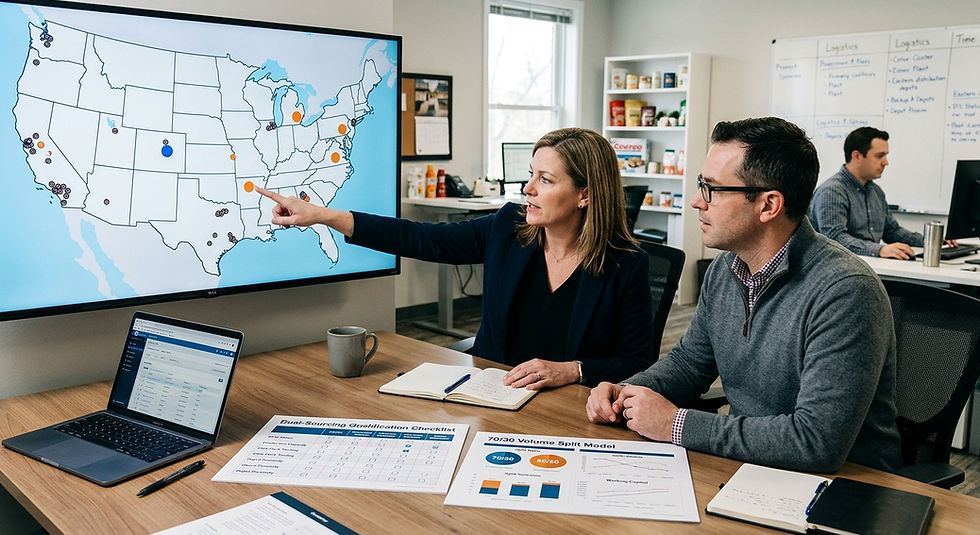
If 2026 had a supply chain slogan, it would be: "Nice single-source you've got there. Hope nothing happens."
That darkly humorous observation from a retail supply chain consulting firm communicates the specific commercial risk that the 2026 supply chain environment has made impossible to ignore: the single-source CPG brand in the Costco channel is one production failure, one co-manufacturer quality event, one ingredient shortage, or one tariff-driven cost disruption away from the OTIF failures and buyer relationship damage that can unravel years of commercial relationship building in a single purchase order cycle.
The single-source supply chain was commercially defensible when supply chains were stable, ingredient costs were predictable, and production disruptions were rare. The 2026 environment has eliminated all three of those conditions simultaneously. Tariff volatility has made ingredient and packaging sourcing unpredictable. Post-pandemic production disruptions have made co-manufacturing capacity genuinely constrained in multiple categories. And the regulatory environment — food safety alerts, allergen recalls, ingredient supply chain disruptions — has demonstrated that any single production relationship can be interrupted without warning.
For CPG brands in the Costco channel, the OTIF consequences of a supply disruption are specific and commercially damaging: a missed delivery generates a chargeback, a persistent OTIF failure generates a yellow or red scorecard status, and a pattern of supply disruptions becomes the buyer's basis for questioning whether the brand's operational infrastructure is adequate to sustain the commercial relationship. The brand that manages supply disruptions without OTIF failures — because it has a qualified backup co-manufacturer ready to produce within the lead time required — is the brand whose buyer relationship is protected from the specific commercial damage that the single-source supply chain cannot prevent.
Dual sourcing means qualifying more than one factory for the same product, component, or material, then running one as your primary and keeping the other warm as a backup. This guide covers the complete Costco dual-sourcing strategy for CPG brands in 2026 — the 70/30 model, the GFSI qualification requirements for the backup co-man, the cash flow design that makes dual sourcing viable without doubling working capital, the backup activation protocol, and the buyer conversation advantage that dual-source supply chain capability creates.
The Single-Source Risk in the Costco Context: What Can Go Wrong
The Five Single-Source Disruption Scenarios
The five specific production disruption scenarios that the Costco vendor's single-source supply chain is most vulnerable to — and that the dual-sourcing strategy is designed to protect against:
Scenario 1: Co-manufacturer quality event
The co-manufacturer's facility experiences a food safety event — a positive environmental monitoring result for Listeria, a foreign material contamination discovery, an allergen cross-contact incident — that triggers a voluntary production hold or an FDA-mandated production suspension. During the production suspension, the brand cannot fulfill Costco's purchase order from the primary co-manufacturer.
The single-source brand's options: delay the purchase order delivery (OTIF failure), find an emergency alternative co-manufacturer (virtually impossible within the Costco lead time window without prior qualification), or deliver a partial order (in-full failure). None of these options avoids the OTIF chargeback and buyer relationship impact.
The dual-source brand's option: activate the pre-qualified backup co-manufacturer, redirect the purchase order to the backup facility, and fulfill the delivery on time and in full. The buyer receives the purchase order as scheduled and the supply disruption is managed operationally rather than commercially.
Scenario 2: Ingredient supply disruption
A key ingredient — a functional protein, a specialty oil, a botanical extract — becomes unavailable or significantly more expensive due to a supplier quality issue, a weather event affecting the crop, or a trade disruption affecting the import pathway. The primary co-manufacturer cannot produce the formula without the unavailable ingredient.
The dual-source supply chain's advantage here is not just about backup production capacity — it is about backup ingredient sourcing. The brand that has qualified backup ingredient suppliers alongside a backup co-manufacturer has a supply chain resilience architecture that addresses the ingredient layer of the disruption risk, not just the production layer.
Scenario 3: Co-manufacturer capacity constraint
The primary co-manufacturer's production schedule becomes constrained by a larger client's unexpected volume requirement, a line maintenance event, or a labor disruption. The co-manufacturer cannot accommodate the brand's purchase order within the required production timeline — and the brand has no alternative production option.
The 70/30 dual-source model is specifically designed for this scenario: the backup co-manufacturer who produces 30% of the brand's regular volume is a facility that is producing the brand's product consistently, whose operators are familiar with the formula and the FRS-compliant packaging configuration, and who can absorb the additional 70% volume on relatively short notice — because the qualification, tooling, and production learning curve have already been completed.
Scenario 4: Tariff-driven cost disruption
An ingredient, packaging component, or finished goods import tariff creates a cost shock that makes the primary co-manufacturer's production economics commercially unviable at the Costco wholesale price. The brand needs to find alternative production at a lower cost before the next purchase order cycle.
The dual-source brand that has a qualified domestic or USMCA-sourced backup co-manufacturer has both the production alternative and the buyer conversation advantage:
"We have already qualified a domestic backup production source that can serve this program at competitive cost" is a significantly stronger tariff-resilience demonstration than "We are exploring alternative sourcing options."
Scenario 5: Co-manufacturer exits the relationship
The co-manufacturer terminates the production relationship — due to business consolidation, a portfolio decision to focus on larger clients, or a commercial dispute — with less notice than the brand's Costco lead time requirement can accommodate.
This scenario is relatively rare but commercially catastrophic for the single-source brand: the co-manufacturer relationship termination creates a production gap that cannot be filled in less than 8 to 12 weeks — the minimum timeline for qualifying a new co-manufacturer, completing the GFSI scope review, and executing the first production run. The Costco purchase order cycle during this gap generates OTIF failures that the brand cannot prevent.
The 70/30 Dual-Source Model: The Commercial Design
Why 70/30 Is the Optimal Split
Dual sourcing means qualifying more than one factory for the same product, component, or material, then running one as your primary and keeping the other warm as a backup — typically 70 to 80 percent of volume going to the primary and 20 to 30 percent going to a qualified second source.
The 70/30 split's specific commercial logic for the Costco vendor context:
The 30% volume at the backup co-manufacturer keeps the facility operationally current on the brand's product — familiar with the formula, the FRS-compliant packaging configuration, the pallet build requirements, and the SSCC-18 label generation process. A backup co-manufacturer that has not produced the brand's product in six months has accumulated a production learning curve that makes emergency volume absorption significantly more time-consuming and error-prone than a facility that produces the product regularly.
The 30% volume provides the minimum production frequency that the backup facility needs to maintain GFSI certification compliance for the brand's product category within its scope. A GFSI certification that covers the product category requires the certified process to be in regular operation — a co-manufacturer that is certified for a product category but has not produced in that category for an extended period may have certification scope questions that the Costco Addendum audit's unannounced format would surface.
The 30% volume is commercially manageable from a working capital perspective — it does not require the brand to maintain two full production runs simultaneously, but it does maintain the backup facility's operational readiness to absorb 70% additional volume on short notice.
The Cash Flow Design for 70/30 Dual Sourcing
The most common reason CPG brands cite for not implementing dual sourcing is the working capital concern: two sets of MOQs, two production cycles, and two sets of packaging inventory commitments appear to double the capital requirement.
The practical cash flow design that makes 70/30 dual sourcing viable without doubling working capital:
The primary co-manufacturer fulfills 70% of each purchase order's production requirement in a single run. The backup co-manufacturer fulfills 30% of each purchase order's production requirement in a coordinated but separate run. Both production runs use the same packaging materials — purchased in a single aggregate order that covers both facilities' requirements.
The aggregate packaging order's economics: purchasing packaging for 100% of the production volume in a single order generates the same per-unit packaging cost as a single-source order of equivalent total volume. The packaging is then split between the two facilities based on their respective production runs — which requires the packaging supplier to deliver to two locations rather than one, but does not require two separate packaging orders at full MOQ.
The ingredient purchasing economy: similarly, purchasing ingredients for the combined production volume of both facilities in a single procurement action maintains the volume-based pricing that the aggregate purchase generates, rather than purchasing two smaller quantities at higher per-unit ingredient cost.
The net working capital impact of 70/30 dual sourcing: approximately 10 to 15 percent above the single-source working capital requirement — reflecting the modestly higher coordination and logistics cost of the split-facility production model — rather than the 100 percent increase that two fully independent production programs would generate.
The GFSI Qualification Requirements: The Compliance Foundation
What Makes the Backup Co-Man GFSI-Qualified for Costco
The backup co-manufacturer must meet the same GFSI qualification requirements as the primary co-manufacturer — described in detail in the co-manufacturer selection guide — to be eligible for use in the Costco program. A backup co-manufacturer that cannot fulfill a purchase order within the Costco Addendum's audit scope requirements is not a backup — it is a production alternative that would trigger a quality compliance event on the next Costco Addendum audit.
The GFSI qualification requirements for the backup co-manufacturer:
Current GFSI certification with the correct scope covering the brand's product category — verified through the certification body's current certificate and the most recent audit report.
Costco Addendum status — either already completed or in active progress with a qualified certification body. The backup co-man that has not completed the Addendum audit cannot be used for Costco production without triggering the supply chain change notification that the reformulation guide identifies as the buyer notification requirement.
Club-pack tooling — the corrugated case tooling, the primary packaging configuration, and the SSCC-18 label generation capability that the Costco FRS requirement mandates. A backup co-manufacturer without prior club-pack experience requires a tooling investment and a club-pack trial production run before it can fulfill a purchase order reliably.
Depot routing compliance — established carrier relationships on Costco's routing guide and EDI infrastructure for ASN transmission within the required pre-pickup window.
The Qualification Timeline
The backup co-manufacturer qualification timeline — assuming the facility already has current GFSI certification in the correct category — is approximately 8 to 16 weeks from the initial qualification visit to the first production run:
Weeks 1-2: facility audit against the co-manufacturer selection checklist — allergen management, SSCC-18 capability, club-pack tooling, capacity utilization.
Weeks 3-6: Costco Addendum scope review notification to the certification body — confirming the backup facility's production of the brand's product falls within the existing certification scope.
Weeks 7-10: club-pack trial production run — producing a trial quantity at the backup facility to validate the FRS compliance, the packaging quality, and the pallet build compliance.
Weeks 11-14: SSCC-18 label validation and EDI ASN transmission test — confirming the backup facility's electronic data infrastructure integrates correctly with Costco's depot receiving system.
Weeks 15-16: first commercial production run at 30% program volume — integrating the backup facility into the regular production rotation.
Total timeline: 16 weeks from qualification initiation to operational integration at 30% volume.
The brand that starts the qualification process 16 weeks before it expects to need the backup facility has built the resilience infrastructure in time. The brand that starts the qualification process when the primary co-manufacturer's disruption has already occurred has started 16 weeks too late.
The Backup Activation Protocol: The 48-Hour Response Framework
When and How to Activate the Backup
The backup co-manufacturer activation protocol defines the specific decision triggers and operational steps that convert the qualification into commercial production when the primary co-manufacturer's disruption event occurs.
The activation trigger framework:
Red alert (activate immediately): the primary co-manufacturer has communicated a production hold that will extend beyond 5 business days — any extension beyond 5 days creates OTIF risk given Costco's purchase order delivery window.
Yellow alert (prepare to activate): the primary co-manufacturer has communicated a capacity constraint that may affect the next purchase order's production timeline — activate the backup preparation process while monitoring the primary situation's resolution.
Green (no activation): the primary co-manufacturer is operating normally — continue the regular 70/30 production split without emergency activation.
The 48-hour activation execution:
Hour 0-4: communicate the disruption to the fractional brand manager and the Costco buyer simultaneously — the buyer notification protocol described in the supply disruption section of the vendor compliance guide.
Hour 4-12: contact the backup co-manufacturer to confirm production availability for the required volume and timeline — the pre-established relationship and the regular 30% production volume mean this conversation is not an emergency introduction but a volume increase request with a familiar production partner.
Hour 12-24: confirm ingredient and packaging availability at the backup facility — the pre-qualified ingredient and packaging suppliers should be notified of the volume increase concurrently with the backup co-manufacturer confirmation.
Hour 24-48: production initiation confirmed at the backup facility, purchase order delivery timeline confirmed to the Costco buyer, supply disruption communication documented for the OTIF scorecard record.
The Buyer Conversation Advantage: The Commercial Value of Demonstrated Resilience
Why Dual Sourcing Is a Buyer Relationship Asset
The dual-sourcing infrastructure's commercial value extends beyond OTIF protection — it is a buyer relationship asset that differentiates the brand from the single-source competitors whose supply chain fragility the buyer has experienced commercially.
The buyer who has managed through a vendor's supply disruption — receiving the "we have a production issue" email three weeks before the delivery window — has experienced the specific commercial disruption that the single-source supply chain creates. The brand that proactively communicates its dual-sourcing capability in a QBR is communicating supply chain resilience that the buyer values as a commercial partnership quality rather than merely a logistics detail.
The specific buyer conversation: "We have qualified a backup co-manufacturer at [location], who produces 30% of our regular volume on the current production rotation. In the event of a primary facility disruption, we can maintain your delivery schedule with a 48-hour activation of the backup facility." This statement converts what is usually an operational detail into a commercial partnership demonstration that distinguishes the brand from competitors who cannot make the same commitment.
At Fractional Brand Managers, we guide CPG brands through the complete dual-sourcing strategy for the Costco channel — backup co-manufacturer identification and qualification, GFSI compliance assessment, club-pack tooling investment planning, cash flow model for 70/30 production split, and the backup activation protocol that protects OTIF compliance from the supply disruption events that the single-source supply chain cannot survive.
Contact us at 732-433-7873 or info@fractionalbrandmanagers.com.
Costco Dual Sourcing 2026 — Complete Implementation Framework:
Step | Timeline | Action | Commercial Output |
Backup co-man identification | Week 1 | Apply co-man selection checklist to 2-3 candidates | Ranked candidate list with qualification gaps identified |
GFSI scope confirmation | Week 3-6 | Notify certification body of backup facility addition | Confirmation that backup scope is within existing certification |
Club-pack trial run | Week 7-10 | Trial production at backup facility | FRS compliance validated, pallet build confirmed |
EDI/SSCC-18 validation | Week 11-14 | ASN transmission test with Costco depot | Electronic compliance confirmed |
30% volume integration | Week 15-16 | First commercial production run at backup | Operational dual-sourcing active |
Ongoing maintenance | Continuous | Backup facility produces 30% each purchase order cycle | Production familiarity maintained, certification compliance sustained |
The 70/30 working capital math: Combined packaging + ingredient procurement at aggregate volume = same per-unit cost as single-source. Net additional working capital: 10-15% above single-source (vs. 100% if fully independent).
The 48-hour activation protocol: Hour 0-4 → buyer + backup notification. Hour 4-12 → capacity confirmation. Hour 12-24 → ingredient/packaging confirmation. Hour 24-48 → production initiation confirmed.
The buyer conversation advantage: "We maintain a pre-qualified backup co-manufacturer producing 30% of our regular volume. 48-hour activation in a disruption event." → Supply chain resilience as a commercial partnership differentiator.
#CostcoDualSourcingCPGBrandSupplyChain2026 #CostcoDualSourcing2026 #CPGDualSourcing2026 #CostcoSupplyResilience #CostcoBackupCoMan
#CostcoSingleSourceRisk #CPGSupplyChainResilience2026 #CostcoOTIFProtection #FractionalBrandManagers #CostcoChannel2026 #CPGBrands2026 #CostcoVendor2026 #CPGSupplyChain2026 #GetIntoCostco2026 #CPGStrategy2026 #CostcoCoManBackup


Comments